What is the Process to Produce Labels Effectively?
In the dynamic world of packaging, the ability to effectively produce labels is paramount. Recent industry reports indicate that over 60% of consumers judge a product by its label design. This highlights the critical role labels play in attracting customers. Experts agree that the label production process must be both efficient and creative. Jack Thompson, a leading figure in the packaging sector, stated, "Labels are not just tags; they tell a story." This perspective emphasizes the importance of purpose behind label design.
Companies need to balance automation and creativity when producing labels. For instance, while digital printing technology enhances efficiency, it sometimes lacks the tactile quality of traditional methods. It's vital to assess how different techniques align with market demands. Additionally, businesses must keep an eye on sustainability practices in label production. Industry studies reveal that 70% of consumers prefer eco-friendly labels. This statistic signals a need for continuous reflection on sustainable practices in the label manufacturing process.
Challenges remain in gauging consumer preferences accurately. Miscommunication during the label design phase can lead to disappointing results. Thus, collaboration between designers and marketers becomes essential. Focusing on effective strategies to produce labels could be the key to unlocking greater market potential.

Understanding the Importance of Effective Label Production
Effective label production is crucial in various industries. Labels convey vital information, making them essential for product identification. A clear and appealing label can enhance customer experience significantly. It attracts attention and communicates quality. However, many companies overlook the details.
Understanding the importance of effective label production begins with recognizing its role in branding. Labels serve as the first point of contact with customers. This initial impression can drive purchasing decisions. Companies must ensure quality materials are used and that designs reflect brand values. Yet, some designs may not translate well in print. It's important to test and revise.
Moreover, a label can become outdated quickly. Regulations change, and market trends evolve. Companies need to stay updated with these dynamics. Failing to do so can result in miscommunication with customers. Labels should be revisited periodically to ensure relevance. Reflecting on these practices helps businesses improve and stay competitive.
Identifying Label Requirements and Specifications
Identifying label requirements and specifications is crucial. It starts with understanding the product. What is the product's nature? How will it be used? Answering these questions can shape what your labels need.
Consider the materials. Different surfaces require different types of adhesive. For instance, glass surfaces may need stronger adhesives. Think about colors too. Color choices can affect visibility and appeal. Reflect on your audience's preferences and avoid using too many colors that might confuse customers.
You must address legal requirements. Different regions may have specific labeling laws. Failure to comply can lead to issues. It's important to research these requirements early in the process. Don't forget about durability. Labels should withstand moisture, scratches, and fading. If labels don't hold up, it may affect customer trust.
Assess your initial choices, and don't hesitate to revise them. Each detail matters in creating effective labels.
Choosing the Right Materials and Printing Techniques
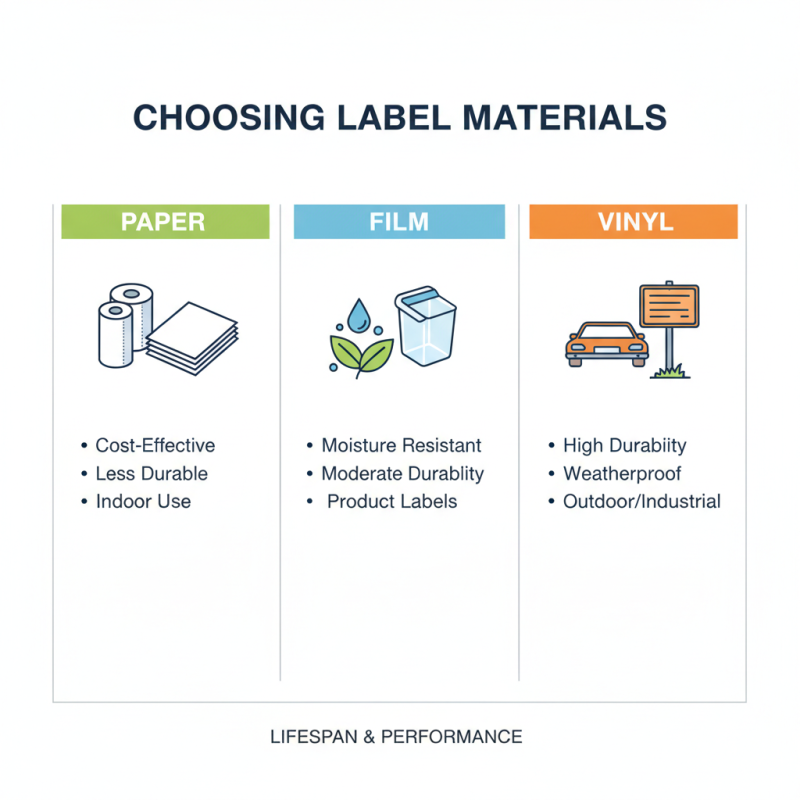
Choosing the right materials is crucial in label production. Paper, film, and vinyl are popular options. Paper is often cost-effective but less durable. For products exposed to moisture, film provides better resistance. Vinyl is great for outdoor labeling but can be pricier. Each material has unique qualities that can affect the label's lifespan and performance.
Printing techniques also play a significant role. Options like digital printing and flexography can vary greatly in quality and cost. Digital printing offers flexibility for small batches. It allows for quick changes in design. However, it may not always produce the best colors for every material. Flexography, on the other hand, is efficient for larger runs but can be slow for adjustments.
Reflecting on your choices is important. Sometimes, cheaper materials may not meet your needs. Investing in quality can save money in the long run. Poor label performance can lead to misunderstandings or damage. It's often better to take the time to evaluate options thoroughly. Ignoring these details can compromise a product’s presentation and usability.
Implementing Quality Control Measures During Production
Quality control is essential in label production. It ensures that every label meets industry standards and customer expectations. During production, there are several checkpoints to consider. These checkpoints help identify issues early in the process.
Visual inspections can be effective. They allow workers to catch flaws like misalignment or color inconsistencies. However, relying solely on visual checks is not foolproof. Human errors can happen. Some defects may remain unnoticed. Therefore, automated systems can play a role. They can detect discrepancies that the human eye might miss.
Another important aspect is testing the adhesive properties. Labels must stick properly to surfaces. If they don’t, it reflects poorly on the production team. Keeping records of testing results helps track performance over time. Regular reviews of these records can reveal patterns and areas for improvement. It’s crucial to acknowledge not every batch will meet perfection. Reflecting on mistakes will lead to better practices in the future. Quality control is a journey, not a destination.
What is the Process to Produce Labels Effectively? - Implementing Quality Control Measures During Production
| Step |
Description |
Quality Control Measure |
Frequency |
| 1 |
Design the Label |
Review designs against branding standards |
At each design stage |
| 2 |
Material Selection |
Check material specifications |
Each batch |
| 3 |
Printing Process |
Conduct print quality checks |
Every hour |
| 4 |
Finishing Touches |
Inspect labels for defects |
Per batch |
| 5 |
Packaging |
Verify correct labels are used |
Each order |
Streamlining Packaging and Distribution for Labels
Efficient packaging and distribution of labels is crucial for any business. The process begins with precise design and printing, ensuring they meet industry standards. Yet, even small errors can lead to costly delays. Streamlining production can help avoid these issues. For instance, integrating automation in the printing process can reduce human error, but it requires upfront investment and training.
Once labels are printed, logistics plays a key role. Proper storage is important to prevent damage. Using climate-controlled spaces can help maintain quality. Distribution should be organized efficiently. Tracking shipments in real-time can minimize lost or misplaced labels. However, over-reliance on technology can sometimes backfire. Manual checks are still necessary to ensure accuracy.
Feedback from users is vital in this section too. Regularly assessing the process allows for improvements. Many companies overlook this step, often assuming their systems are perfect. Adopting a culture of continuous improvement can be beneficial. Taking the time to reflect on each stage of the process will lead to better outcomes in the long run.